
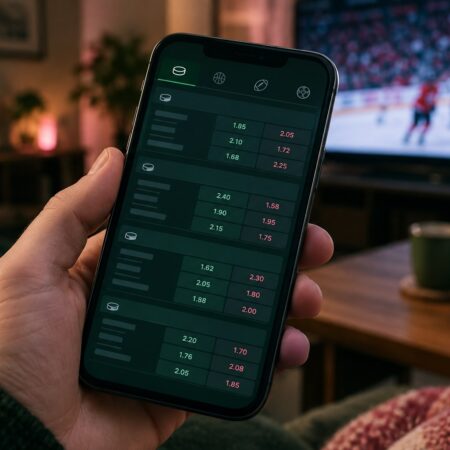
Betting odds explained simply means understanding
what a sportsbook price represents, how it relates to probability
and how it determines the potential return from a winning wager.
This WildRosePlay guide explains how betting odds work,
including sports betting odds, decimal odds, fractional odds,
American odds, implied probability, sportsbook margin,
betting payouts and odds movement.
What Are Sports Betting Odds?
Sports betting odds are prices attached to
outcomes in a betting market. They help describe the potential
return from a winning wager and can also be converted into
an implied probability.
Market Price
Odds show the current price offered for a particular
betting selection.
Potential Return
The price helps determine how much can be returned
if the wager is settled as a win.
Implied Probability
Odds can be translated into a percentage representing
the raw probability suggested by the price.
Market Comparison
Different sportsbooks can offer different odds
for the same eligible outcome.
Changing Price
Odds can move before and during an event.
Sportsbook Margin
Market prices normally include a built-in margin
across the available outcomes.
Three Common Sports Betting Odds Formats
The same underlying market price can be displayed in different
formats depending on the sportsbook and user preference.
Decimal Odds
Commonly used in Canada and many international markets.
They show the potential total return relative to the stake.
Fractional Odds
Traditionally associated with the UK and Ireland.
They express potential profit relative to the stake.
American Odds
Common in North American sports betting and displayed
using positive or negative numbers.
How Decimal Odds Work
Decimal odds show the potential total return
for each unit staked, including the original stake when
a qualifying wager wins.
Example: 2.00
A $10 winning wager at decimal odds of 2.00 would produce
a total return of $20, including the original $10 stake.
Example: 1.50
A $10 winning wager at 1.50 would produce a total
return of $15, including the original stake.
Potential total return = stake × decimal odds.
Decimal Odds – Profit and Total Return
It is important to distinguish the potential total return
from potential profit.
Total Return
Includes the original stake plus the profit generated
by a winning wager.
Profit
The amount remaining after the original stake
is subtracted from the total return.
A $20 wager at 2.50 has a potential total return of $50.
The potential profit is $30.
How Fractional Odds Work
Fractional odds show potential profit relative
to the amount staked.
2/1
A 2/1 price means a winning wager can produce two units
of profit for every one unit staked.
5/2
A 5/2 price represents five units of potential profit
for every two units staked.
1/2
A 1/2 price represents one unit of potential profit
for every two units staked.
How American Odds Work
American odds use positive and negative numbers
to express the relationship between stake and potential profit.
Positive Odds
Positive prices such as +150 show the potential profit
on a $100 stake.
Negative Odds
Negative prices such as -150 show approximately how much
must be staked to produce $100 in profit.
At +150, a $100 winning wager produces $150 in profit.
At -150, approximately $150 must be staked to produce
$100 in profit.
Different Odds Formats Can Represent the Same Price
Decimal, fractional and American formats can look very different
while representing approximately the same underlying betting price.
| Decimal | Fractional | American | Raw Implied Probability |
|---|---|---|---|
| 2.00 | 1/1 | +100 | 50% |
| 1.50 | 1/2 | About -200 | About 66.7% |
| 3.00 | 2/1 | +200 | About 33.3% |
Small differences can appear when prices are rounded
during conversion between formats.
What Is Implied Probability?
Implied probability converts betting odds into
a percentage representing the probability suggested by the price.
Decimal Formula
Raw implied probability = 1 ÷ decimal odds × 100.
Example
Decimal odds of 2.50 correspond to a raw implied
probability of 40%.
The percentage calculated directly from sportsbook odds
is a price-derived probability. It should not automatically
be treated as the true probability of the sporting outcome.
Favourite and Underdog Odds
Sportsbooks use shorter prices for outcomes considered more
likely and longer prices for outcomes considered less likely
according to the market.
Favourite
A favourite generally has shorter odds because its estimated
probability of winning is higher.
Underdog
An underdog generally has longer odds because its estimated
probability of winning is lower.
A favourite can lose and an underdog can win.
How Betting Payouts Are Calculated
Betting payouts depend on the odds, stake
and final settlement of the wager.
Stake
The amount of money risked on the wager.
Price
The odds determine the relationship between the stake
and potential return.
Settlement
The wager must satisfy the applicable market conditions
before the quoted winning return applies.
What Is Sportsbook Margin?
Sportsbook margin is reflected when the combined
implied probabilities of the prices across all outcomes
exceed 100%.
Fair Probability
In a theoretical market without margin, the probabilities
across all mutually exclusive outcomes would total 100%.
Quoted Market
Sportsbook prices can produce a combined raw implied
probability above 100%.
Price Comparison
Comparing prices helps show when one available market
offers a different return from another.
What Is Overround?
Overround is a common term for the amount by which the combined
raw implied probabilities in a betting market exceed 100%.
Example Market
If two opposing selections are each priced at 1.91,
each has a raw implied probability of about 52.36%.
Combined Probability
Adding the two percentages gives about 104.72%,
illustrating the margin built into the quoted market.
Why Sports Betting Odds Move
Odds movement occurs when sportsbooks adjust
their prices or betting lines before or during an event.
Team News
Injuries, suspensions and lineup changes can alter
market expectations.
Weather
Relevant weather changes can affect expectations
in some outdoor sports.
Market Activity
Sportsbooks can respond as prices change
across the wider betting market.
New Information
Confirmed news can alter how likely an outcome
is considered to be.
Time
Prices can change as an event approaches
and more information becomes available.
Live Action
In-play prices can move continuously as
the score and game situation change.
Which Odds Apply to Your Bet?
The relevant price is normally the price accepted when
the wager is successfully confirmed, subject to the sportsbook’s
applicable terms and acceptance process.
Price Changes
The displayed odds may move after a selection
is added to the betting slip.
Review Before Submission
Check the current price shown before confirming
the wager.
Bet Confirmation
Review the final accepted details after
the wager has been submitted.
Why Compare Sportsbook Odds?
Different sportsbooks can quote different prices
for comparable eligible markets.
Same Selection
One sportsbook may offer a different price
from another for the same outcome.
Different Lines
Spread and total markets can differ in both
the numerical line and the attached odds.
Check Settlement Rules
Make sure markets are truly comparable before
treating two quoted prices as equivalent.
How Odds Work Across Different Bet Types
Moneylines, point spreads, totals, props, parlays and futures
can all use betting odds, but the underlying market conditions
are different.
Moneyline
The price is attached directly to the selected
winner or qualifying match result.
Spread & Totals
The betting line and the price together determine
the offered wager.
Parlays
Prices from multiple selections are combined
to form the overall parlay price.
Common Mistakes When Reading Betting Odds
Understanding odds means looking beyond the size of
the potential payout.
- Confusing total return with profit.
- Assuming shorter odds guarantee a winning result.
- Choosing longer odds only because the payout is larger.
- Ignoring the probability implied by the price.
- Comparing odds without checking whether the markets use the same rules.
- Ignoring sportsbook margin when evaluating quoted prices.
- Assuming an odds move proves what will happen in the event.
- Increasing a stake because a price appears attractive.
A Simple Process for Understanding Betting Odds
Use the same basic checks whenever you review a sportsbook price.
Identify the Market
Make sure you understand exactly which sporting
outcome the odds apply to.
Read the Odds Format
Determine whether the sportsbook is displaying
decimal, fractional or American odds.
Calculate the Potential Return
Check how the offered price interacts with
the stake amount.
Consider Implied Probability
Translate the price into a percentage if
probability comparison is useful.
Check the Final Price
Review the odds again before submitting
the wager.
Continue Your Sports Betting Guides
Understanding betting odds works best alongside basic wagering,
individual bet types, strategy and bankroll management.
How to Bet
Learn how sportsbooks, betting slips,
stakes and settlement work.
Bet Types
Explore moneylines, spreads, totals,
parlays, props and futures.
Betting Strategies
Learn about value, line shopping,
pricing and stake sizing.
Bankroll Management
Learn how to manage betting budgets,
stakes and spending limits.
Latest Betting Odds Articles
Browse WildRosePlay articles covering decimal odds,
fractional odds, American odds, implied probability,
sportsbook margin, payouts and betting prices.
Explore Sports Betting Sites in Alberta
This guide explains betting prices rather than ranking sportsbook
operators. For information about platforms available to Alberta
players, visit the dedicated WildRosePlay sportsbook section.
Odds Do Not Change Your Gambling Budget
Longer odds can display a larger potential payout, but that
does not mean more money should be risked on the wager.
Set Your Budget First
Decide how much discretionary money is available
before looking at potential payouts.
Control Stake Size
Choose stakes according to your budget rather
than the size of the possible return.
Do Not Chase
Longer prices do not provide a reliable method
for recovering previous losses.
Odds Explain the Price – Not the Future
Betting odds describe a market price and potential payout,
but they cannot guarantee what will happen in a sporting event.
Even short-priced favourites can lose.
Set limits for money and time, avoid chasing losses
and never bet with money required for essential expenses.
WildRosePlay betting odds content is provided for informational
and educational purposes. Sports betting involves financial risk
and uncertain outcomes. Odds, probability calculations and market
analysis cannot guarantee winnings. Please gamble responsibly.